
When Is a Picture Worth a Thousand Words? What New Research Reveals About Visual Context in AI Translation
As AI continues to reshape translation workflows, advances in vision-language models (VLMs) have made it possible to combine text and images when generating translations.

As AI continues to reshape translation workflows, advances in vision-language models (VLMs) have made it possible to combine text and images when generating translations. In theory, this additional visual context could help AI resolve ambiguity, interpret terminology more accurately, and produce translations that better reflect the intended meaning of the source content. If a product manual includes a diagram or a marketing campaign features supporting imagery, shouldn’t AI be able to use those visuals to produce a more accurate, context-aware translation?
Those questions are at the center of Is a Picture Worth a Thousand Words? Exploration and Implementation Considerations for Visual Context in Translation Workflows, a research paper by Vera Senderowicz Guerra and Olesia Khrapunova, AI researchers at Welocalize, presented at the 2026 European Association for Machine Translation (EAMT) Conference and published in Volume 2 of the conference proceedings. The study evaluates whether visual context consistently improves machine translation and, perhaps more importantly, identifies the scenarios where images can actually reduce translation quality. Rather than assuming that more context automatically leads to better translations, the researchers set out to understand when images genuinely add value and when they may inadvertently introduce errors into production workflows.
Their findings reveal that visual context is neither universally beneficial nor inherently problematic. Instead, its value depends on the type of translation task, the relevance of the image, and the underlying AI model. For organizations considering multimodal AI in production, the research offers practical guidance for evaluating when visual context should become part of the translation workflow and understanding the type of gains they can expect.
The Promise of Multimodal Translation
Translation has always depended on context. Translators routinely rely on surrounding text, subject matter expertise, and visual cues to resolve ambiguity and produce accurate translations. As organizations create more multimedia content, AI systems increasingly have access to the same visual information.
Technical documentation, user interfaces, e-commerce listings, product packaging, and marketing campaigns often pair text with images. In theory, those images should help AI distinguish between multiple meanings of the same word, interpret terminology correctly, or better understand the intended context.
To test that assumption, Senderowicz Guerra and Khrapunova evaluated six VLMs, including both open-source and proprietary systems, across two established translation benchmarks and a production-style case study. Rather than simply comparing text-only translation with image-assisted translation, they tested four distinct scenarios: no image, the correct image, an unrelated image, and a contradictory image. This methodology allowed the researchers to isolate whether improvements came from meaningful visual context or simply from the presence of an image, and to understand the robustness of models when faced with an image that does not match the source text.
Relevant Images Can Improve Translation Accuracy
One of the clearest findings involved lexical disambiguation, where a single word has multiple possible meanings.
Consider a word like bat. Without context, in certain sentences it could refer to an animal or sports equipment. Humans naturally use surrounding information, including images, to determine the intended meaning. The study found that VLMs can do the same.
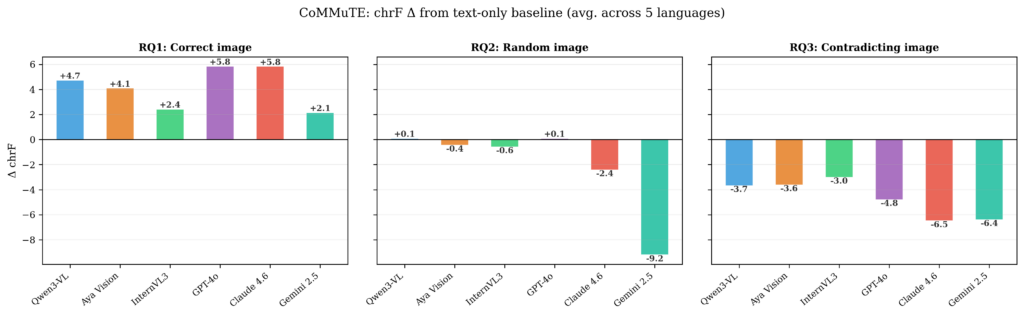
Across five languages, every model evaluated showed measurable improvements when provided with the correct supporting image without being provided with the specific instruction to use that visual context for disambiguation. Translation quality increased by approximately two to nearly six chrF points depending on the model, with GPT-4o and Claude Sonnet 4.6 showing the largest gains. These improvements demonstrate that relevant visual context can help AI make more accurate lexical choices than text alone.
For organizations translating product catalogs, technical manuals, or visual marketing materials, these results are encouraging. When images directly support the accompanying text, multimodal AI has the potential to improve translation quality without requiring additional human intervention.
More Context Does Not Always Produce Better Results
One of the study’s most valuable contributions is demonstrating that additional raw context is not automatically beneficial.
When researchers intentionally paired translation segments with unrelated images, results varied significantly across models. Most open-source models remained relatively stable, showing robustness against irrelevant context,while several proprietary models experienced noticeable declines in translation quality despite the images containing no useful information.
The effects became even more pronounced when researchers introduced contradictory images that suggested the opposite meaning of the source text. In every model tested, translation quality deteriorated under these conditions. Rather than helping the model resolve ambiguity, misleading visuals actively interfered with accurate translation.
This finding has important implications for enterprise localization workflows. Simply making images available to an AI system does not guarantee better translations. If those visuals are unrelated to the specific segment being translated, they may introduce confusion instead of clarity, so developing image-text matching tools to automatically assess an image’s relevance to a specific source text becomes crucial.
Visual Context Is More Helpful for Some Tasks Than Others
The research also explored whether images improve cultural disambiguation, where translators must interpret culturally specific concepts instead of ambiguous vocabulary.
While relevant images clearly benefited lexical disambiguation, those gains did not reliably transfer to culturally dependent translation tasks. Some language pairs showed only modest improvements, while others experienced slight declines. Researchers also observed greater sensitivity to unrelated images during these experiments, particularly among proprietary models.
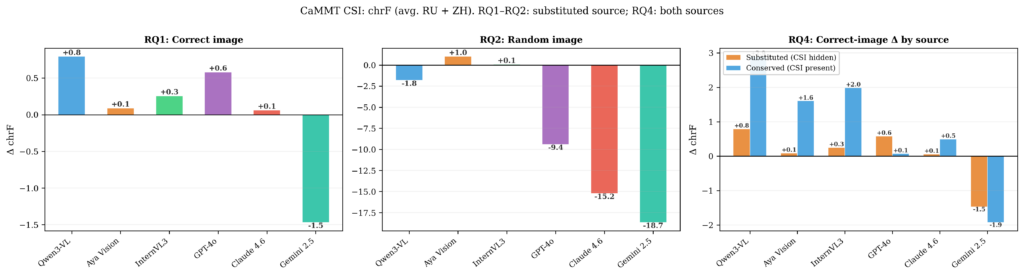
The findings suggest that organizations should avoid viewing multimodal AI as a universal enhancement for every translation scenario. The value of visual context depends on the nature of the linguistic challenge itself.
Production Workflows Introduce a New Layer of Complexity
Research benchmarks provide valuable measurements, but enterprise localization introduces additional challenges. In production environments, images are rarely attached to individual translation segments. A single diagram may accompany an entire section of technical documentation, while one product photo might be associated with dozens of separate text strings. Not every segment actually matches the visual context. Additionally, relationships between images and text are not as straightforward as in benchmarking conditions: the visuals are not usually explicitly mentioned in the text, so information is not repeated but rather complementary.
To better simulate this reality, the researchers conducted a production-style case study using synthetic technical documentation. They compared situations where an image accurately matched the accompanying text with situations where the same image was paired with unrelated content from the same domain.
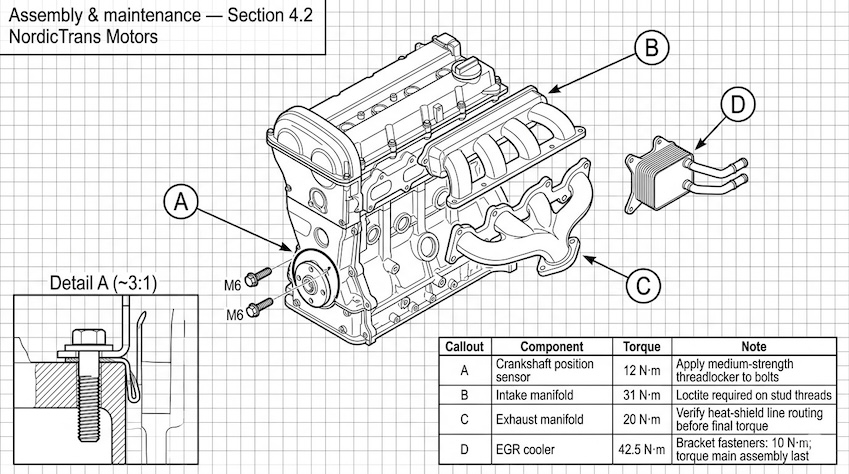
A human review of the translations revealed that when visual context is provided alongside the text, for some languages translations can become more natural and terminology selection can improve, regardless of the relationship between text and image. For other languages, no major quality changes were detected under both conditions. Automatic translation metrics, however, did not suggest these same findings, as they showed improvements for both languages, especially when text and image matched. This suggests that automatic metrics do not always reliably capture quality variations related to context expansion.
Model Selection Matters
Another important takeaway is that VLMs do not respond to visual information in the same way. The researchers observed that open-source models generally remained more robust when presented with unrelated images, while proprietary models showed greater variability. Some proprietary systems achieved the largest improvements when paired with correct images, but they also experienced the greatest declines when those images were irrelevant or contradictory.
For localization leaders, this highlights the importance of evaluating models against real production content rather than relying solely on benchmark performance. The best-performing model may differ depending on how consistently visual assets are managed throughout the content lifecycle. It also states the need for reliable methods for determining the level of relevance of an image before incorporating it into an automated translation workflow.
Evaluation Should Come Before Deployment
Perhaps the most significant message from the research is that multimodal translation should be evaluated as rigorously as any other AI capability before deployment. Visual context clearly has the potential to improve translation quality, but images need to be accurately paired with the source content, and appropriate for the specific translation task. Simply adding images to a workflow without validating their relevance may introduce unnecessary risk.
As enterprises continue to explore multimodal AI, success will depend not on providing models with more information but developing tools to guarantee that they’re providing the right information. Rigorous evaluation across realistic production scenarios remains the most reliable way to determine when visual context adds value and when it may become a liability.
Research Sources
Is a Picture Worth a Thousand Words? Exploration and Implementation Considerations for Visual Context in Translation Workflows, by Vera Senderowicz Guerra and Olesia Khrapunova, presented at the 2026 European Association for Machine Translation (EAMT) Conference, June 2026.
Tackling Ambiguity with Images: Improved Multimodal Machine Translation and Contrastive Evaluation (CoMMuTE), which focuses on lexical disambiguation by evaluating how images help machine translation systems resolve words with multiple possible meanings.
CaMMT: Benchmarking Culturally Aware Multimodal Machine Translation (CaMMT), which evaluates cultural disambiguation, measuring how effectively multimodal translation systems interpret culturally specific concepts and references when visual context is available.


 Dan O’Brien
 Erin Wynn
 Chris Grebisz
 Christy Conrad
 Matt Grebisz
 Siobhan Hanna
 Kimberly Olson
 Nicole Sheehan