
Document-Level Context Improves AI Post-Editing When It Provides Actionable Guidance
Welocalize researchers explore how to provide the right context to help large language models make better decisions.

As enterprise translation workflows increasingly rely on large language models (LLMs), the question is no longer whether AI can improve translation quality, but how to provide the right context to help those models make better decisions.
New research from Welocalize, presented at the 2026 AMTA Conference, explores an often-overlooked opportunity: document summarization. Rather than asking an AI model to post-edit translated segments in isolation, the researchers tested whether providing a concise, document-level summary could improve post-editing quality across real-world enterprise content. The answer was nuanced. Context alone was not enough. The tone of that context made all the difference.
The study evaluated 448 production documents spanning 37 target locales and 13 content specialties, representing nearly four million source words. Instead of simply adding more information to the prompt, researchers compared summaries generated by different LLMs and examined how their style influenced downstream translation quality.
“Many post-editing workflows still operate at the segment level, even though documents have broader context that influences terminology, tone, and consistency,” said Vera Senderowicz Guerra, AI/ML Engineer at Welocalize and lead author of the study. “We wanted to understand whether giving AI that higher-level understanding of the document would help it make better editing decisions.”
Better Context Doesn’t Mean More Context
The research began with a straightforward hypothesis: if human translators benefit from observing the full document, AI systems should as well. To test that theory, the team created a workflow that generated summaries describing each document’s content, purpose, audience, structure, terminology, tone, formatting requirements, and translation considerations before AI-based post-editing began. Those summaries were then added to the prompts used during automated post-editing, allowing researchers to compare translation quality against a baseline workflow that relied only on style guides and historical translation memories.
The results demonstrated that not all summaries are equally valuable. Summaries generated with Gemini 2.5 Flash Lite included more assertive post-editing indications and warnings, and consistently improved translation quality, producing stronger edit distance improvements and higher COMET scores than both the baseline workflow and GPT-4o-generated summaries. Meanwhile, more generic, descriptive summaries generated by GPT-4o actually reduced quality across every evaluation metric.
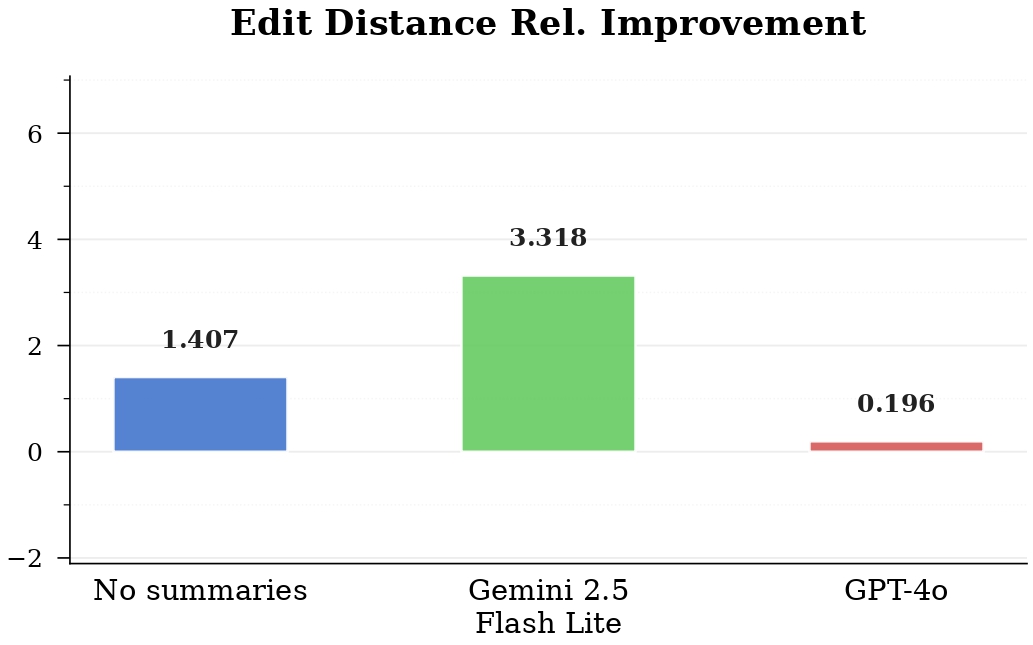
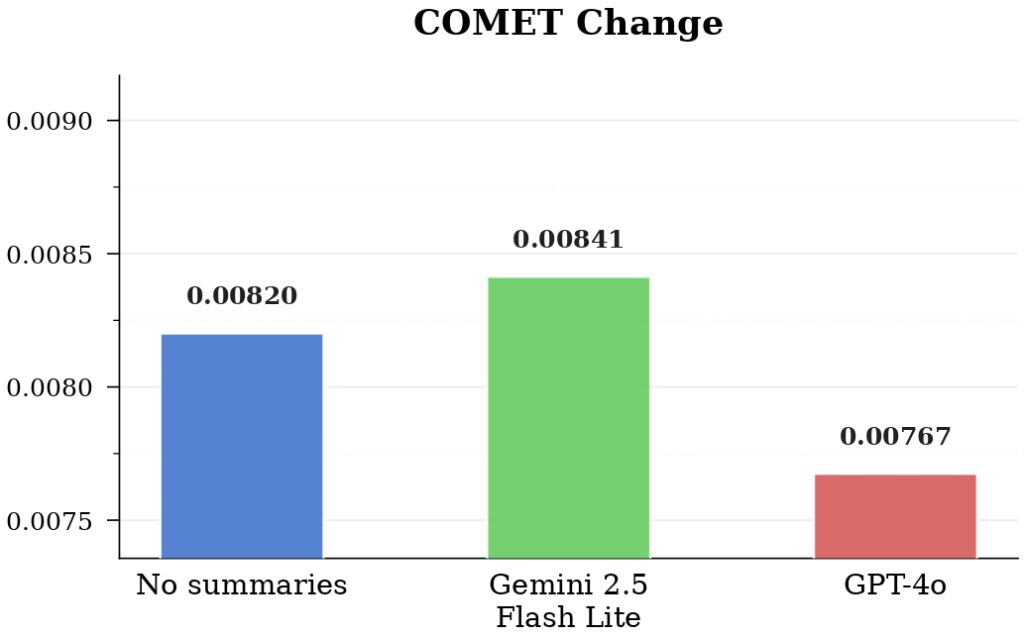
“Our findings show that simply adding document context isn’t enough,” Senderowicz Guerra said. “The context has to tell the model what matters. Specific, directive guidance around terminology, style, and domain conventions helps AI make better decisions. Generic summaries simply introduce noise.”
Specificity Drives Better AI Decisions
One of the study’s most important findings was that summary content mattered more than summary presence. Researchers observed that the most successful summaries did not simply describe a document. Instead, they highlighted specific terminology that required consistency, identified regulatory or industry conventions, emphasized formatting requirements, and pointed out areas likely to create translation challenges.
Those actionable signals allowed the post-editing model to make more targeted revisions without increasing the amount of editing performed. In other words, the AI was not working harder. It was working smarter. Conversely, summaries that were vague, incomplete, contradicting, or overly descriptive frequently pushed the model toward unnecessary or incorrect edits.
“The lesson isn’t that one model is universally better than another,” Senderowicz Guerra explained. “It’s that prompt outputs need to be evaluated for the downstream task they are supporting. A summary that reads well to a human isn’t necessarily the summary that helps AI produce the best post-editing.”
The Biggest Gains Appeared Where Post-Editing Is Most Difficult
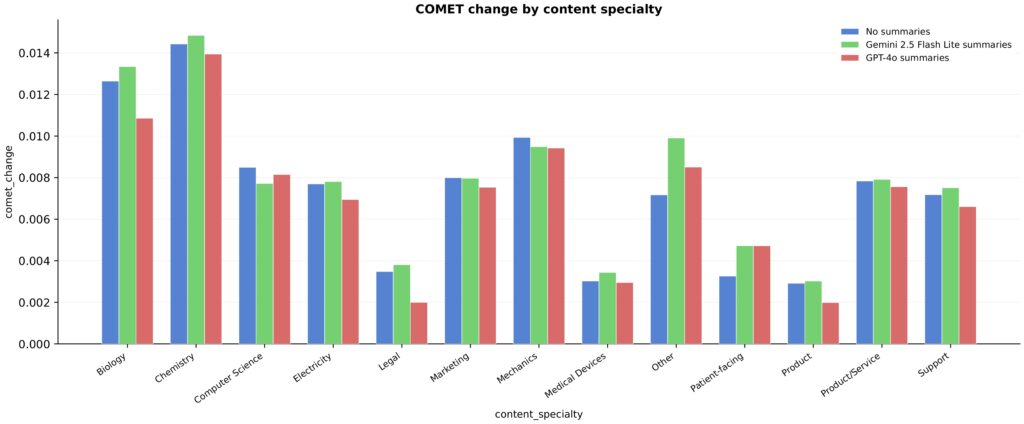
The improvements were not evenly distributed across every content type. Researchers found the strongest gains in highly specialized domains such as biology and legal content, where terminology and regulatory language play a critical role. Document summaries also proved particularly helpful in cases where the baseline AI post-editing system struggled, including patient-facing and medical device content, suggesting that additional document context can help reduce harmful editing decisions when translations are inherently more ambiguous.
The study also identified larger improvements across several target locales, where machine translation quality is often less consistent.
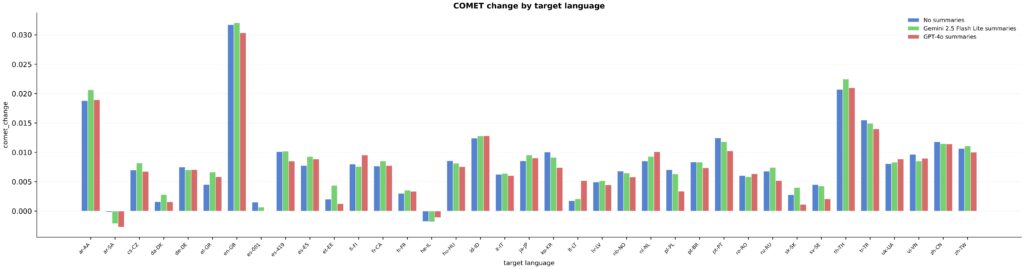
“Lower-resource languages often have fewer examples available during model training,” Senderowicz Guerra said. “When the model receives clear guidance about terminology and document intent, that additional information can compensate for some of those limitations.”
Human Review Explained Why It Worked
While automated metrics showed measurable improvements, the research team also conducted qualitative human evaluations to understand why.
They found that document summaries improved post-editing performance in three primary ways. First, they helped AI pay closer attention to technical terminology, proper nouns, capitalization, and domain-specific conventions. Second, summaries made it easier for the model to detect missing or incomplete translations. Finally, they improved the quality of the AI’s own reasoning by producing more context-aware editing decisions.
Equally important, researchers found that summaries generally did not encourage unnecessary editing. When translations already met quality expectations, the AI largely left them unchanged.
“The summaries that helped most served as practical guidance and intermediate decision-making steps rather than additional content,” Senderowicz Guerra said. “That distinction matters because enterprise translation and post-editing areultimately about making precise decisions.”
Building Smarter Enterprise AI Workflows
The findings have implications that extend well beyond translation. Many enterprise AI workflows increasingly rely on retrieval, prompt engineering, and contextual information to improve performance. This research suggests that organizations should pay just as much attention to the quality and style of that context as they do to model selection.
Rather than assuming more information automatically produces better results, the study demonstrates that carefully curated, task-specific guidance can deliver measurable quality improvements while reducing the risk of unintended outputs.
Looking ahead, the research team plans to explore whether AI systems can predict when document summaries are likely to improve translation quality based on the type of text, language pairs, and certain qualities of the content, allowing organizations to selectively apply them only when they provide measurable value. They also intend to compare summary-augmented workflows with emerging long-context translation approaches to better understand the tradeoffs between distilled context and full-document processing.
For enterprises deploying multilingual AI at scale, the takeaway is straightforward: better AI outcomes depend not only on choosing the right model, but also on providing guidance with the right level of granularity. As this research demonstrates, thoughtfully designed document summaries can help AI systems make more accurate, consistent, and contextually appropriate translation decisions across complex global content.
Research Source
This article is based on findings from Document Summarization for AI-based Post-Editing, a research paper presented at the 2026 Association for Machine Translation in the Americas (AMTA) Conference. The study was authored by Vera Senderowicz Guerra, Dimitrios Pavlou, Peter Bourgonje, Olesia Khrapunova, Konstantinos Karageorgos, and Aaron Schliem of Welocalize, and examines how document-level summaries can improve AI-based post-editing quality across multilingual enterprise translation workflows.


 Dan O’Brien
 Erin Wynn
 Chris Grebisz
 Christy Conrad
 Matt Grebisz
 Siobhan Hanna
 Kimberly Olson
 Nicole Sheehan